📖 Summarize this post with AI:
ChatGPT | Perplexity | Claude | Grok
⚡ Key Takeaways
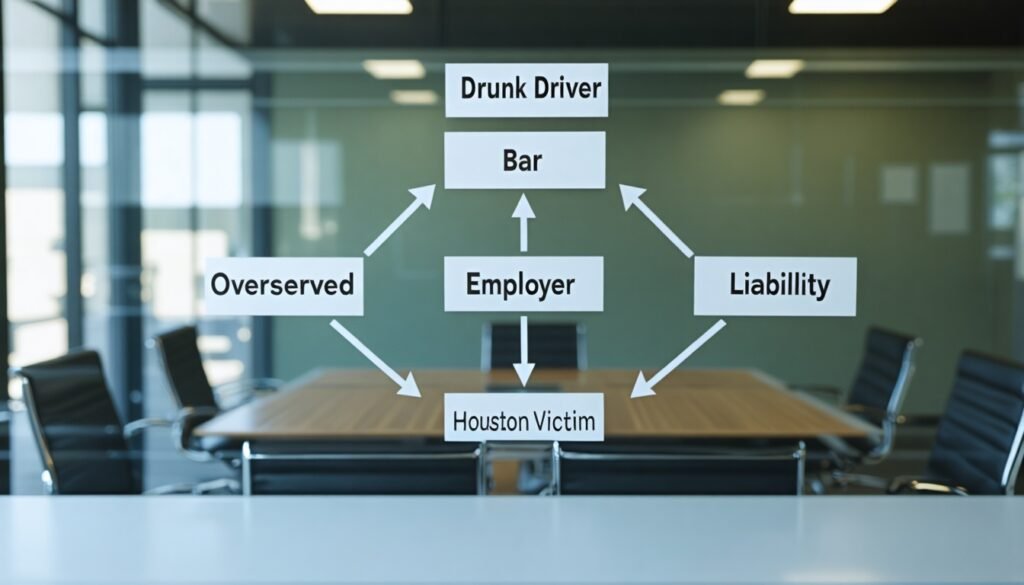
- An overserved drunk driver accident lawyer in Houston pursues third-party claims against all parties — beyond the driver — whose negligence contributed to the crash and your injuries.
- Third-party liability in Houston DUI crashes includes bars (dram shop law), employers (respondeat superior), vehicle owners (negligent entrustment), and rideshare companies in specific circumstances.
- Each third-party defendant carries separate insurance coverage — pursuing all applicable third-party claims dramatically expands total available compensation.
- Third-party claims require different evidence, different legal theories, and different expert witnesses than the primary claim against the drunk driver.
- The most time-sensitive third-party evidence — bar surveillance, employer records, and rideshare dispatch data — disappears within 24 to 72 hours of the crash.
- Texas comparative fault law allows fault percentages to be divided among all third-party defendants — each pays their proportionate share of total damages.
An overserved drunk driver accident lawyer in Houston recognizes that the drunk driver is rarely the only party whose negligence contributed to a crash — and that identifying and pursuing all applicable third-party claims can mean the difference between partial and full compensation for victims of serious or catastrophic DUI injuries. Third-party liability in Houston overserved drunk driver cases extends well beyond the bar that served the alcohol. It includes employers, vehicle owners, rideshare platforms, and others whose independent negligence enabled or facilitated the crash. This guide explains each category of third-party liability, the legal theories that support it, and why pursuing all of them simultaneously is essential to maximizing recovery.
What Is Third-Party Liability in an Overserved Drunk Driver Case?
Third-party liability refers to the civil responsibility of parties other than the drunk driver who contributed to causing the crash and the resulting harm. In overserved drunk driver accident cases, identifying third-party defendants is essential because individual drunk drivers frequently carry insurance limits that are wholly inadequate for serious injuries. By identifying all parties whose negligence contributed to the crash — and pursuing claims against each — the victim gains access to multiple insurance policies simultaneously, significantly expanding the total pool of available compensation. Texas comparative fault law under Texas Civil Practice and Remedies Code Section 33.001 expressly permits fault to be allocated among multiple defendants, each of whom is then responsible for their proportionate share. For a full overview of dram shop and third-party liability claims, see the Houston dram shop liability lawyer hub.
Third-Party Category 1: Dram Shop Liability Against the Bar or Restaurant
The most commonly pursued third-party claim in overserved drunk driver accident cases is the dram shop claim against the bar, restaurant, nightclub, or other licensed alcohol provider that served the driver while visibly intoxicated. Under Texas Alcoholic Beverage Code Section 2.02, a licensed commercial alcohol provider is civilly liable when it serves a visibly intoxicated person who presents a danger to themselves or others, and that intoxication causes injury or death. Commercial general liability policies held by bars and restaurants typically carry limits of $1 million or more — dramatically higher than individual drunk driver policies. Evidence preservation within 48 to 72 hours is essential: bar surveillance footage, point-of-sale records, and staff witness accounts are the core of every dram shop claim.
Third-Party Category 2: Employer Liability (Respondeat Superior and Negligent Supervision)
When the drunk driver was operating a vehicle in the course and scope of their employment at the time of the crash, their employer may be civilly liable under the doctrine of respondeat superior — the principle that employers are responsible for the negligent acts of employees committed during the performance of their job duties. This applies even when the employee’s driving was not specifically authorized, if it was within the general scope of employment. Separately, if the employer knew or should have known that the employee had a history of drunk driving or alcohol-related problems and failed to act, a claim for negligent supervision or negligent retention may arise. Commercial vehicle liability policies carried by employers frequently have much higher limits than individual driver policies, making employer liability a critical avenue in any overserved commercial driver case.
Third-Party Category 3: Negligent Entrustment by Vehicle Owners
If the drunk driver was operating a vehicle owned by another person — a family member, friend, or acquaintance — and the vehicle owner knew or should have known that the driver was intoxicated or had a history of drunk driving, a claim for negligent entrustment may arise under Texas common law. Negligent entrustment occurs when a vehicle owner permits an incompetent, unlicensed, intoxicated, or reckless driver to use their vehicle, and that driver then causes injury to another. The vehicle owner’s personal auto liability policy — which covers permissive use of the vehicle — may provide an additional source of compensation. An overserved drunk driver accident lawyer will investigate who owned the vehicle, the owner’s knowledge of the driver’s condition, and any prior incidents that would have put the owner on notice of the risk.
Third-Party Category 4: Rideshare Platform Liability
If the drunk driver was a rideshare driver operating on a platform such as Uber or Lyft at the time of the crash, the platform’s commercial insurance — which provides up to $1 million in coverage when a driver is actively transporting a passenger — may apply. Even when the driver was between rides but had the app open, the platform’s contingent liability coverage may provide additional compensation beyond the driver’s personal policy. Rideshare liability is a technically complex area that requires rapid evidence collection: dispatch records, trip logs, and platform data are essential to establishing the driver’s status at the time of the crash and must be obtained through formal legal channels quickly after the incident.
Third-Party Category 5: Social Host Liability — What Texas Law Does Not Allow
It is important to note what Texas dram shop law does not cover: social host liability. Under Texas Alcoholic Beverage Code Section 2.02, the dram shop liability applies only to commercial providers — businesses licensed to sell alcohol. A private individual who serves alcohol at a party or social gathering is generally not subject to dram shop liability under Texas law, with one narrow exception: if the host provides alcohol to a minor under Texas Alcoholic Beverage Code Section 2.02(b). Understanding this limitation helps victims and their attorneys focus investigation and claims strategy on the commercial providers where third-party liability exists.
How an Overserved Drunk Driver Accident Lawyer Pursues All Third-Party Claims Simultaneously
The most effective approach to an overserved drunk driver accident case in Houston is simultaneous pursuit of all viable third-party claims from day one — not a sequential approach where one claim is resolved before another is investigated. An experienced attorney will, on the day they are retained: send evidence preservation letters to all bars and restaurants identified as potential dram shop defendants; request employer records and commercial vehicle documentation; identify the vehicle owner and their insurance coverage; obtain rideshare dispatch and trip data if applicable; and begin the forensic investigation of all contributing negligent parties. This parallel approach maximizes total available compensation, creates strategic leverage with all insurers simultaneously, and ensures no time-sensitive evidence is lost. For more on the evidence strategy underlying DUI cases, see our guide on what evidence helps a Houston drunk driving injury case most.
What is a third-party claim in a Houston overserved drunk driver case?
A third-party claim is a civil lawsuit against any party other than the drunk driver — the bar that overserved them, their employer, the vehicle owner, or a rideshare platform — whose independent negligence contributed to the crash. Each third-party defendant carries separate insurance coverage, and pursuing all viable claims simultaneously maximizes total available compensation.
Does Texas dram shop law apply to private parties who hosted a party?
No. Texas Alcoholic Beverage Code Section 2.02 applies only to commercial, TABC-licensed alcohol providers — businesses. Private social hosts who serve alcohol at parties or gatherings are generally not subject to dram shop liability under Texas law, with the narrow exception of providing alcohol to a minor under Section 2.02(b).
About This Guide
Produced by the editorial team at Houston Drunk Driving Lawyers Guide. Legal references cite current Texas statutes. For informational purposes only. Not legal advice.